

Doesn’t everything die at last, and too soon?
Tell me, what is it you plan to do
with your one wild and precious life?
—Mary Oliver, The Summer Day
We were all gathered for Grandma’s 93rd birthday for a feast. I was sitting towards one of the corners of the table. The active banter from my partner and his whole lot of family and relatives, the squeals from the kids, and the pitter-patter of their feet faded into a hum.
Suddenly, I detached from where I was. I looked at myself, a woman very out of place, surrounded by people who looked nothing like her and spoke in a language she did not grow up in.
What is she doing there? How did she get there?
Look at the little girl she once was—huddled in a corner of a little house on a small dot of north peninsular Malaysia, reading her way into faraway lands and fantasy worlds—no one could ever draw a straight line from her to the woman she is now.
No doubt, as the little girl closed the book to Heidi, a seed was planted, and it’ll be three decades before she drives past the Alps with the love of her life, wondering how she got here. And from all the worlds she explored, imagined or real, that same seed sprouted—and she would go on adventures to every corner of the world.
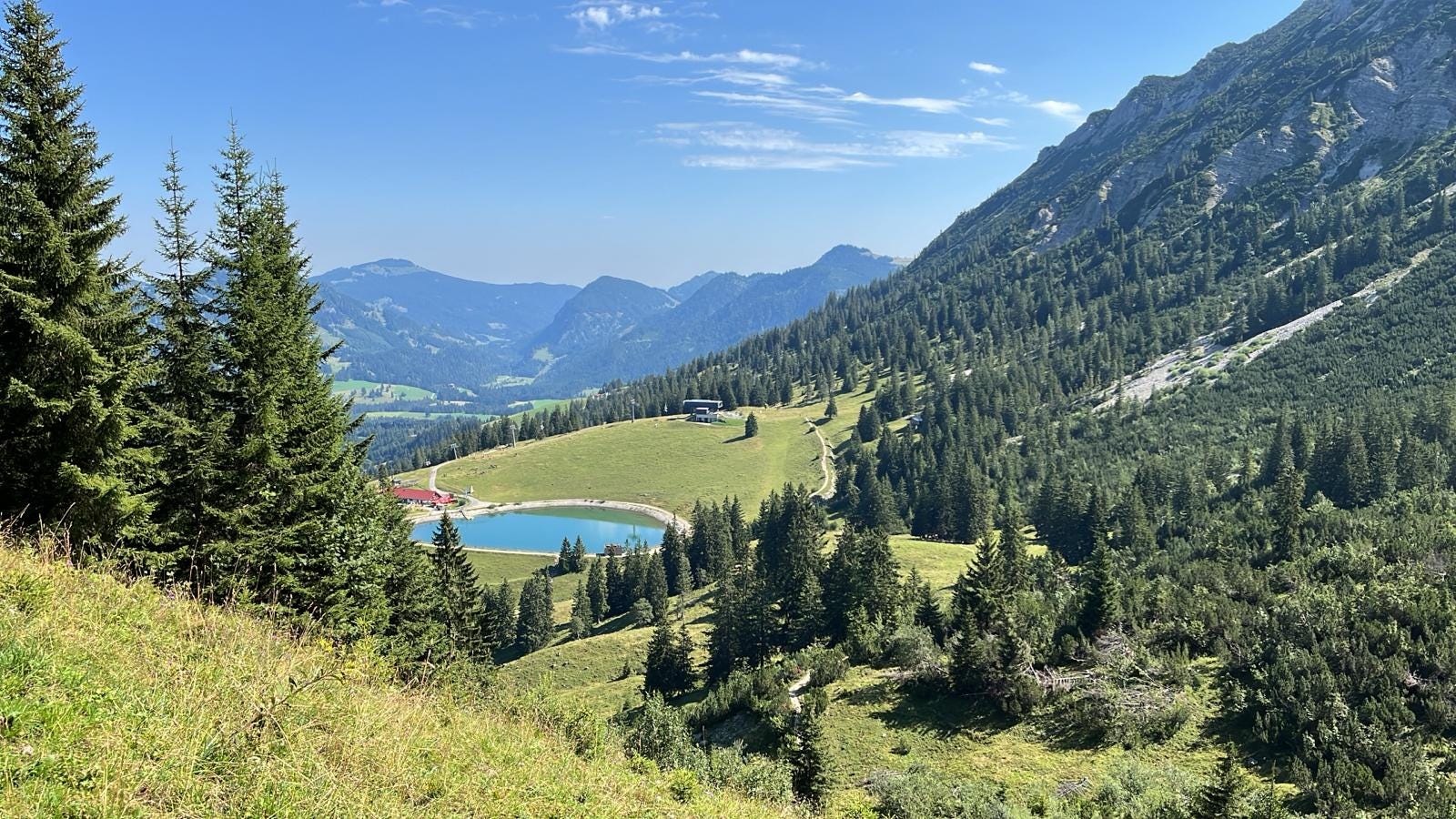
But still, no one, certainly not even herself, could have imagined she would end up traveling the world solo, moving across continents, learning a new language, and raising children in a foreign land, straddling the mixed cultures she grew up in.
Somewhere in between, life rose into itself, lost itself, and found its way back again—revealing what truly mattered and what didn’t.
Back then, after I quit my day job to reclaim my life, my first instinct was to achieve financial freedom. I carried within me the old pull of self-sustenance, passed down by my great-grandparents as they sailed across the South China Sea to the Promised Land in search of a better life, leaving everything they knew behind.
This blood of self-reliance, of trust in self, of hope in life, and of courage to pursue, will forever flow in me.
Even though—spoiler—I did not achieve financial freedom as planned, I have learned so much more. I learned what it meant to be sentenced to freedom, and how to handle it effectively, authentically, and responsibly.
I learned I needed routine. I set the alarm clock so I could wake before the sun reached its peak overhead. I learned the cost of every yes—yes to a friend’s social call, yes to a family or friend’s crisis management, and yes to yet another book.
All the extra time I saved from commuting, I spent working out in my studio apartment, looking out at the long chain of cars on the freeway—where once, I was one of the links. These little moments reminded me why I chose a different path.
A path that strayed from the script handed to me: study hard, get the degree, land a big-company job, and be set for life.
This script took shape over generations since my ancestors set roots in the Promised Land. It was a recipe for a better life, but happiness asks for different ingredients.
Somehow deep down, I knew the recipe wasn’t for me. I did not want a 9-5 grind in the rat race. I devoured Rich Dad, Poor Dad1 like it was an almanac—it confirmed everything I already suspected, though let’s be honest, he never would have done it without the Rich Dad.
Most of us don’t have one, and so, like the rest, I joined the rat race. I hopped from job to job, each time getting more and more money, but to what end?
I had a quarter-life crisis at 25—a privilege that is not lost on me. By then, I was earning more than I needed, alone without children, and my parents were still healthy and working. I had enough time to pause and think.
Is that all there is?
Before I could answer, everything happened almost at once—my grandmother passed away, my five-year relationship ended, and soon after, I fulfilled my childhood dream of visiting my godsister in the UK, only to have the trip cut short when my father underwent his third open-heart surgery.
It took everything in me to hand over all my savings for it. I was raised on scarcity, raised to believe that money was the key to happiness.
But in hindsight, it was nothing. I did not miss the money at all. And it bought my father another fifteen years of life. It was priceless. I would have given it all again—and more, if I could—to buy him another fifteen. But that option never returned.
Life’s up. No more hearts. Game over.
This wake-up call became both a test and a blessing. I threw away the recipe and spent years flitting in and out of contract jobs, and lived most days on the road. I still look back fondly on those times. My heart warmed; my lips curled.
I was meant to travel, to explore, to get lost, to wander, and to wonder. I was meant to be a vagabond. Or so I thought, until I found myself making a home in a foreign country and even having children.
My partner and I met on the road. In time, my path shifted, and with him I found a home—a place to settle for a while and start a family. Some days, I still wonder about the path we chose; I still ache, now and then, for my carefree vagabond days.
But if you ask me, would I do it all over again? Yes—and yes a thousand times over.
I would cross the oceans, learn a new language, and navigate a foreign land to be with him. I would be a lonely first-time mother out of my element, enduring night after night of sleeplessness and long hours of breastfeeding, just to look into those little trusting eyes. All over again.
The days were long, but the years were short. They still are, though they seem to grow shorter and shorter.
What is it you plan to do with your one wild and precious life?
If this meditation on life stirred something in you, consider supporting my work by—
You may also be interested in:


Rich Dad Poor Dad: What the Rich Teach Their Kids About Money That the Poor and Middle Class Do Not! is a 1997 book written by Robert T. Kiyosaki and Sharon Lechter. It advocates the importance of financial literacy (financial education), financial independence and building wealth through investing in assets, real estate investing, starting and owning businesses, as well as increasing one’s financial intelligence (financial IQ). [1]
What a moving article.
Life really is fragile and precious; the people we meet, the moments we’re given, and the experiences we go through are quiet miracles we don’t slow down to appreciate enough. Each memory, each joy, and even each heartbreak slowly shapes us into who we are today, and that’s something worth holding close and waking up for. It’s always special to be invited into someone’s story like this, to walk beside their journey for a moment and be reminded how short, beautiful, and meaningful our time on this planet can be
Thank you for sharing
Loved reading a bit more about the paths you've taken, what a full and rich life you've lived already and I'm sure there's more to come. Like you, I don't think that little girl that was once me would have ever thought I'd end up where I am now, but I'm so happy I'm here 😊