

I spent a week in Padova, staying at the home of someone I met while backpacking in Java.
In between, we went to Venice to visit another friend who was studying languages there. With him, conversation flowed easily in English. With my Padovan friend, words trickled.
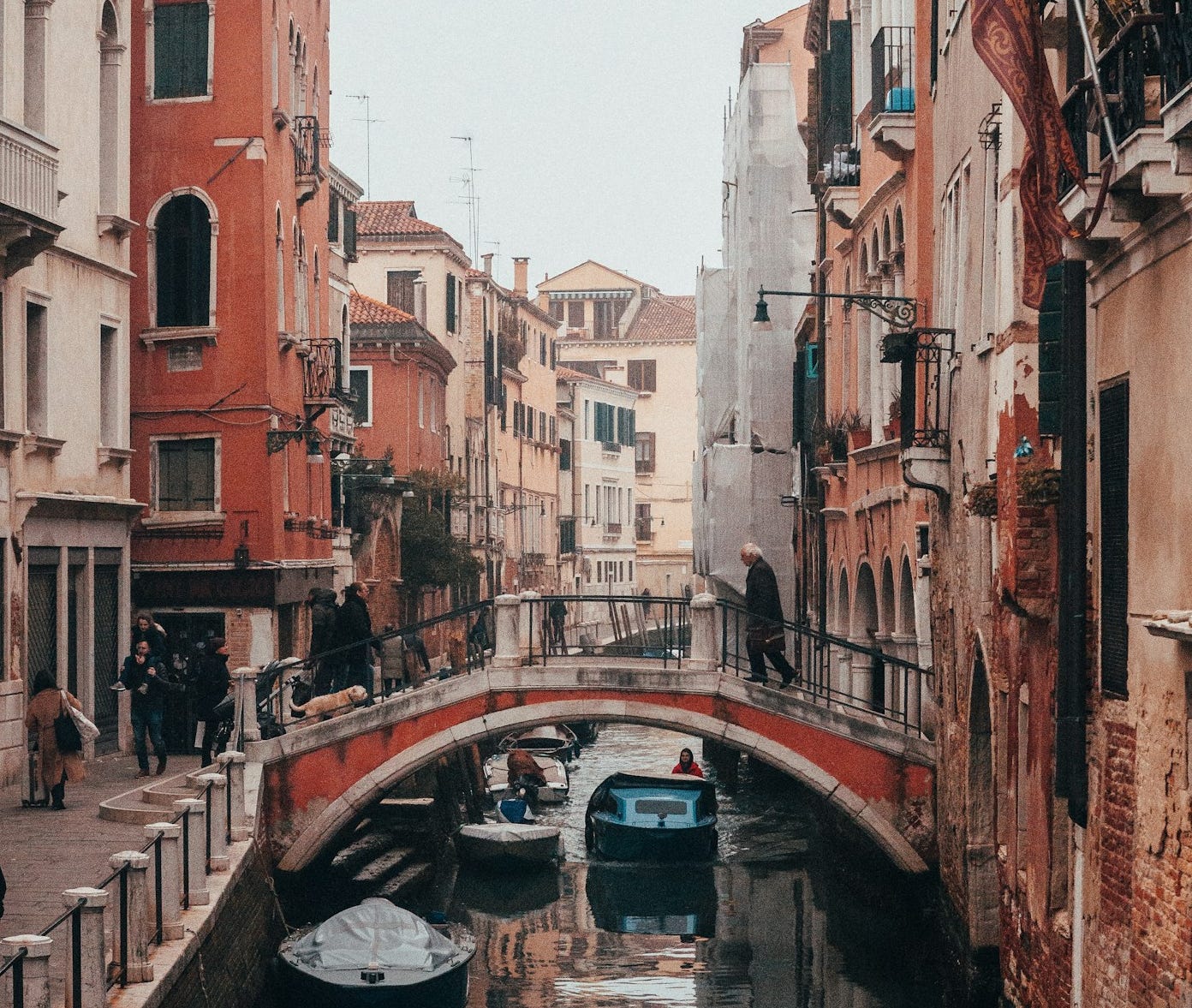
One afternoon, we wandered through Venice. We talked and laughed, gelato melting in our hands. The city glowed in Venetian red; sunlight shimmered on the canals as we crossed bridge after bridge. Only later, when he took me to a quiet stretch at the edge of Venice overlooking the sea, did I realize that something between us had shifted.
On the last day of my visit, he was away at school. I was packed and found myself sunk deep into a red sofa, its velvety cushion enveloping my hips. His housemate walked in and sat on an adjoining seat.
We started talking and did not stop for hours. It was jyun — the quiet convergence of time and place when two lives meet and something clicks.
When the late afternoon rolled in and the color of the room changed from bright yellow to a warm orangey glow, my body twitched to get off the sofa. I checked my MacBook Air: the train runs every hour towards Florence. I could take the next one, or the next next one—or not.
While my heart was still full from our conversations, my brain instructed my fingers to buy the next train and my mouth to release the last words of farewell.
The time to leave good hospitality is a grace one learns as a seasoned backpacker.
As the train rumbled towards Rome and the red sun hovered above the mountain peak, casting the sky in velvet pink, I retreated into myself. Outside, the world slipped by. Inside, I let the familiar ache of parting settle.
Retreating inward is easy for me. Solitude was once my playground; over time, it became routine, and the path quietly narrowed.
But recently, I stepped away from routine and family for a few days of training. It was refreshing to be untethered—to leave the familiar path.
I had the jyun to stay with someone from training at a villa. We spent the evening away together—the white wine flowed as generously as the conversation.
Just as on the red sofa in Padova, connection found me again on a grey sofa in Switzerland.
The very next day, as if the question had been waiting for the right moment, someone at the training asked me, “What drives human conversation?”
After some deliberation, I answered, “Curiosity.”
In German, we have two words for curiosity—Neugier and Wissbegier—one thirst for novelty, another for knowledge.
Both filled the river where my conversations flowed.
The question about human conversation sprang up while we were discussing how to write better prompts for AI. In other words, how to have better conversations with AI.
What then drives human-AI conversation?
Throughout the day, when I need an answer or some assistance, I prompt the AI and move on. But sometimes, I linger into the late evening, my face lit by the glow on the screen, allowing the conversation to stretch longer than necessary.
In those moments, something tilts. Words arrive in abundance, but nothing moves beneath them.
If I had visited my Padovan friend in another future time, our conversation would not have flowed while we walked the meandering paths and crossed the countless bridges of Venice.
We would not have chanced upon a peddler selling ice cream, and I would not have tried the first and best fig gelato of my life, bought on his recommendation.
We would sit across from each other on a bench, our words translated by AI, the rough edges already smoothed before they reach the other.
The Venetian red no longer serves as a backdrop to the romantic scene of a budding friendship but as a curtain closing off human connection.
That evening, as the train continued to rumble towards Florence, I watched the sky turn violet.
Connected Essays


For a brief moment of lightness, I became heavy

On freedom, connection, and the lasting impressions we will leave behind.
Are you there?

Connection to the now, then, and a point in time. Connection to a here, there, and a place.
I loved how you wove in the words for conversations felt for different reasons and what we all might be longing for in so many moments if our conversations jump to AI…,,
This is so beautiful. There's a longing ache in these words.